A culminating activity in an urban ethnographic field school
This workshop was developed for an upper-level undergraduate course (ANTH 480 / SOCI 480) in an urban ethnographic field school at UBC. It uses the Random Ethnographic Vignette Printer as the centrepiece of a 50-minute class session and is designed to work as a culminating activity following a sequence of in-class place-writing exercises leading to this workshop.
Before arriving at this workshop, students worked through four in-class place-writing exercises, each building a different skill and each introducing a concept.
The first asked students to write historical depth into a present scene--that is to let the past surface through an object, a physical trace, or a practice, without explaining it as background. It introduced the concept of the palimpsest: place as a surface that has been written over repeatedly, with earlier layers still visible beneath. The second asked students to write a place without ever naming it, forcing a discipline of showing: without a label to fall back on, the place has to be built through sensory and social texture alone. The third brought Google Street View into the classroom as a tool for temporal observation. Students moved between current and archival street-level images of their community partner's (service leanring placement's) neighbourhood and wrote about what the passage of time makes legible in a place. The fourth was writing a postcard from the field: roughly sixty words, addressed to a specific person, written under the constraint of brevity and in the awareness that the reader was not there.
By the time students arrive at this workshop, they have written place four times in four different registers: historical, sensory, archival, epistolary. The workshop turns the exercise around: instead of producing place-writing, students read it analytically, and connect what they observe in the writing to a set of broader arguments that place-focused ethnographic writing can make.
How the workshop runs
The workshop follows five steps, each on its own slide, with a one-page handout students follow along.
Students begin by coming up to the printer. I filtered the databse and used a subset of the vignette database that included only place-focused vignettes. Stdeunts choose a vignette length (short, medium, or long). The printout includes the vignette text, a full citation, a content warning where applicable, a reflection question specific to that vignette, and a QR code linking to a short lesson on place-writing. No two students receive the same vignette.
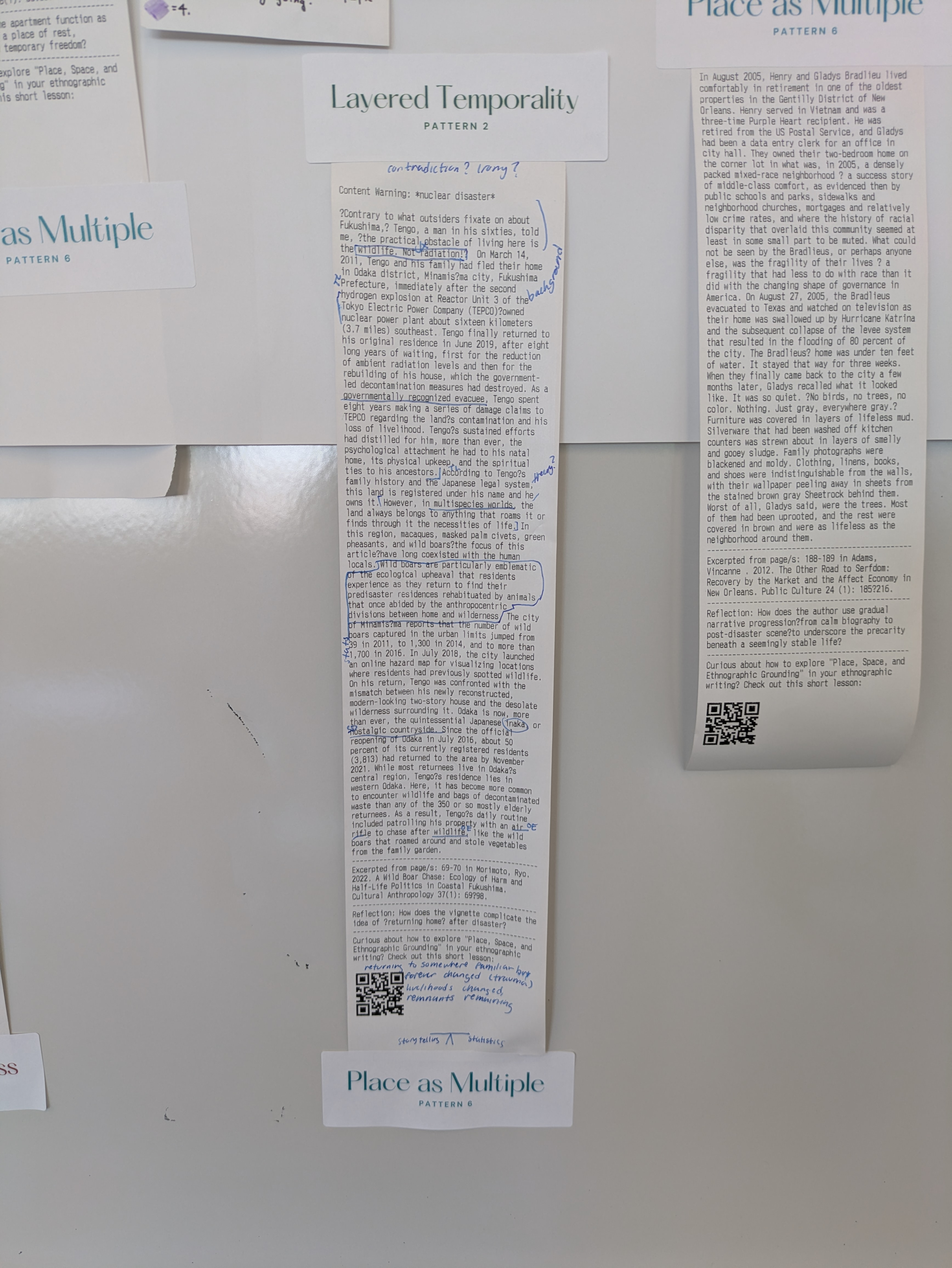
They then read the vignette once without a task--"let the place arrive," as I put it to students, before analysis begins--and then work with the reflection question printed on their receipt, annotating directly on the printed receipt.
In the third step, students analyze the writing itself. The handout provides a vocabulary of five writing techniques as a starting point: Sensory Detail, Temporal Layering, Pacing and Movement, Juxtaposition, and Object Ethnography. Students are encouraged to go beyond this list if they find something it doesn't name.
They then pair up, with discussion prompts that push them from noticing a technique to locating it precisely (pointing to the exact sentence, the specific word choice, the moment where the technique is actually doing something).
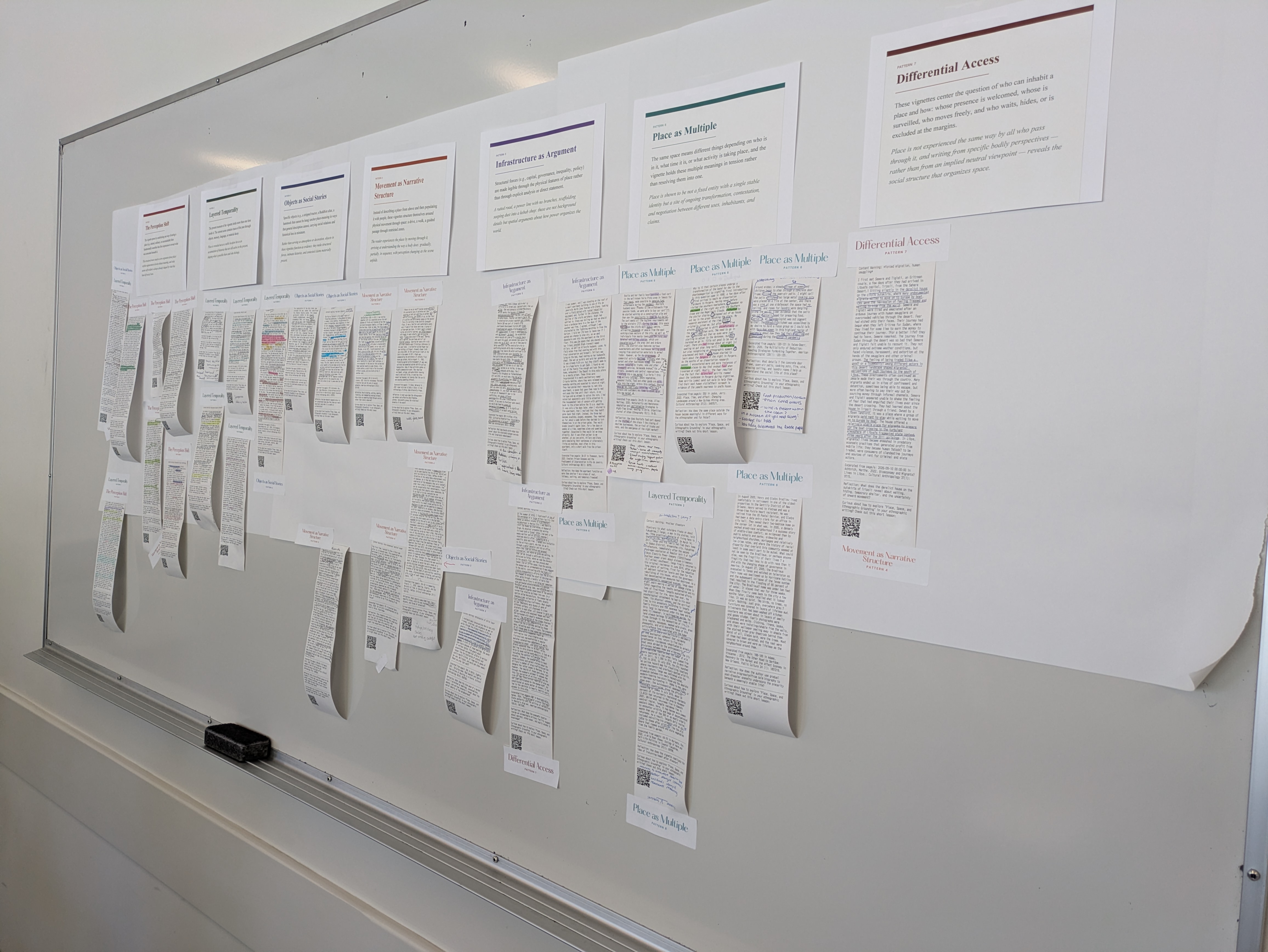
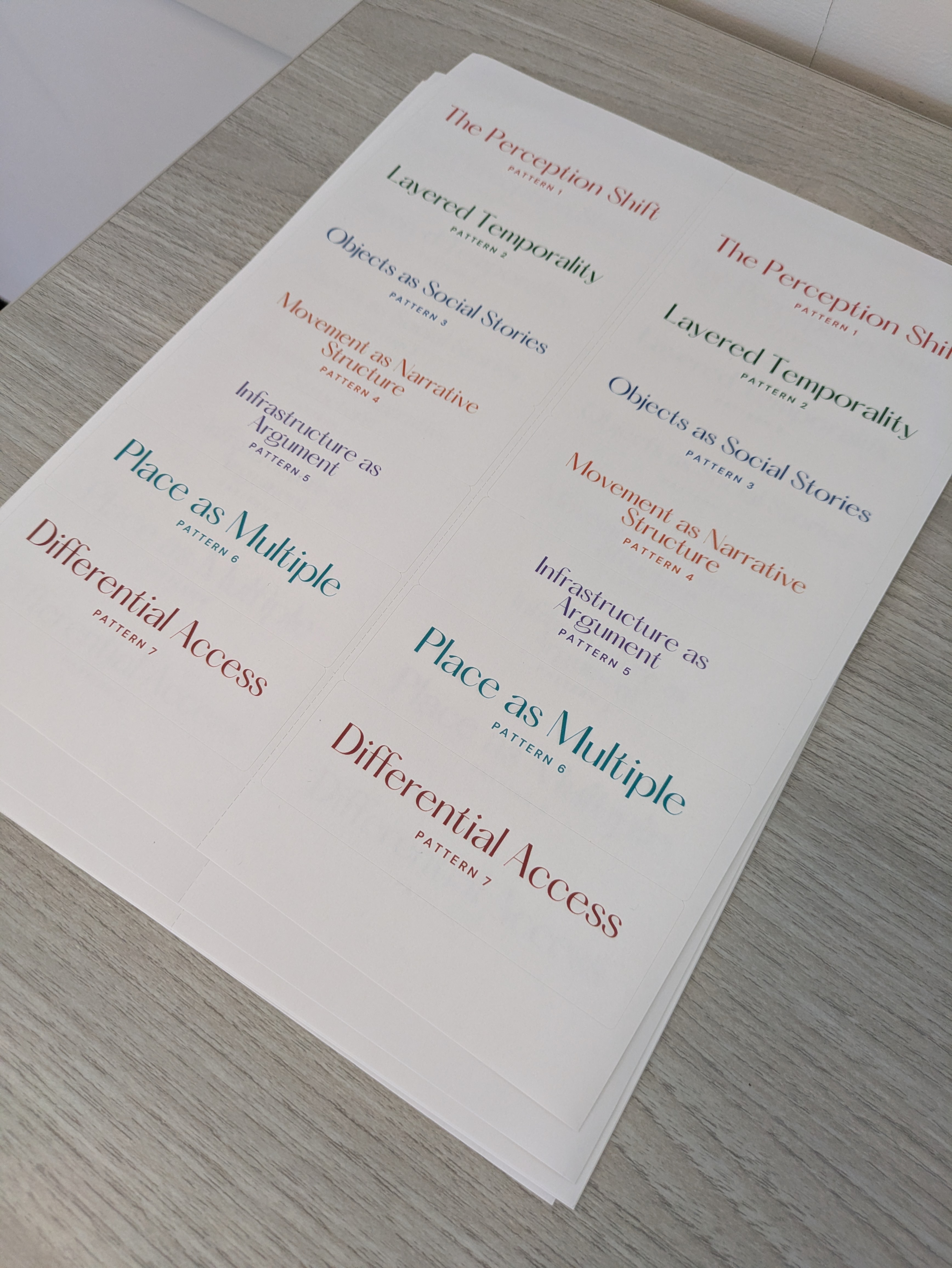
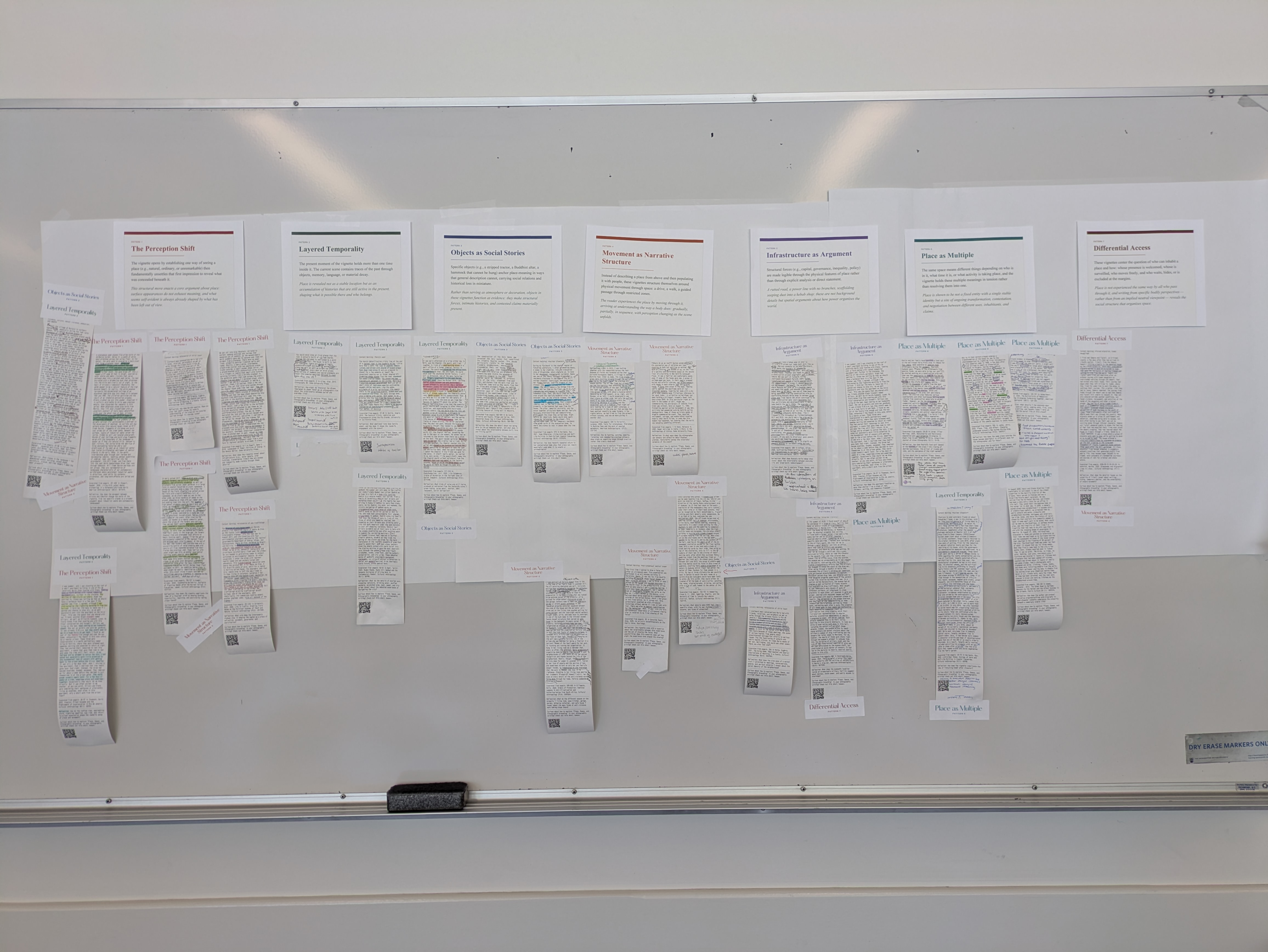
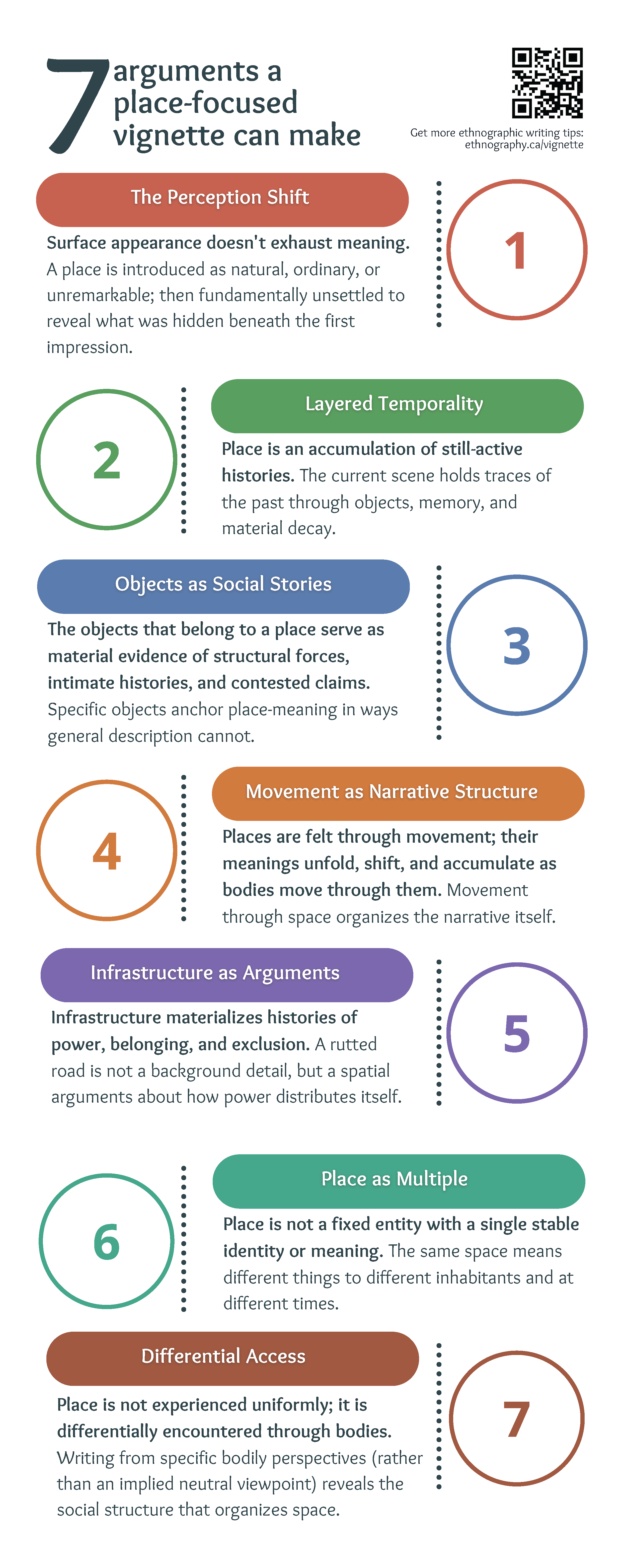
The final step brings everything to the board. Seven pattern cards are shared with students and are taped to the board, each naming one of the approaches the authors of the vignettes take portrating the place they write about. Students choose the pattern most relevant to their vignette, pick up a colour-coded sticker, and tape their receipt under the corresponding card. After posting, they are asked to hang around and read a couple of what their classmates have put up. The board becomes a kind of collective findings page: the class's reading of a set of vignettes no two of them shared.
At the end of the session, students take a copy of the infographic (below; the analytical arguments that place-focused ethnographic writing can make) and are pointed back to the QR-linked place-writing lesson on their receipt. The closing prompt asks whether anything from the workshop applies to their own ethnographic writing.
Materials
The following materials (also linked above) are available for instructors who want to run this workshop. All were developed for the course described here and can be adapted freely.
- The dataset of place-focused vignettes
- Slides: the full slide deck used to run the workshop, including speaker notes
- Handout (one page): a student-facing handout covering all five steps and including the writing technique vocabulary and the seven pattern names
- Pattern cards: the seven pattern cards
- Infographic: "7 arguments a place-focused vignette can make"
Photos